
Representative Case Study: this scenario illustrates how IFBrand Sourcing manages comparable product-development and manufacturing requirements. Client identity and commercially sensitive details are intentionally anonymized.
Project Overview – Coordinating Food Storage, Heat and Portability
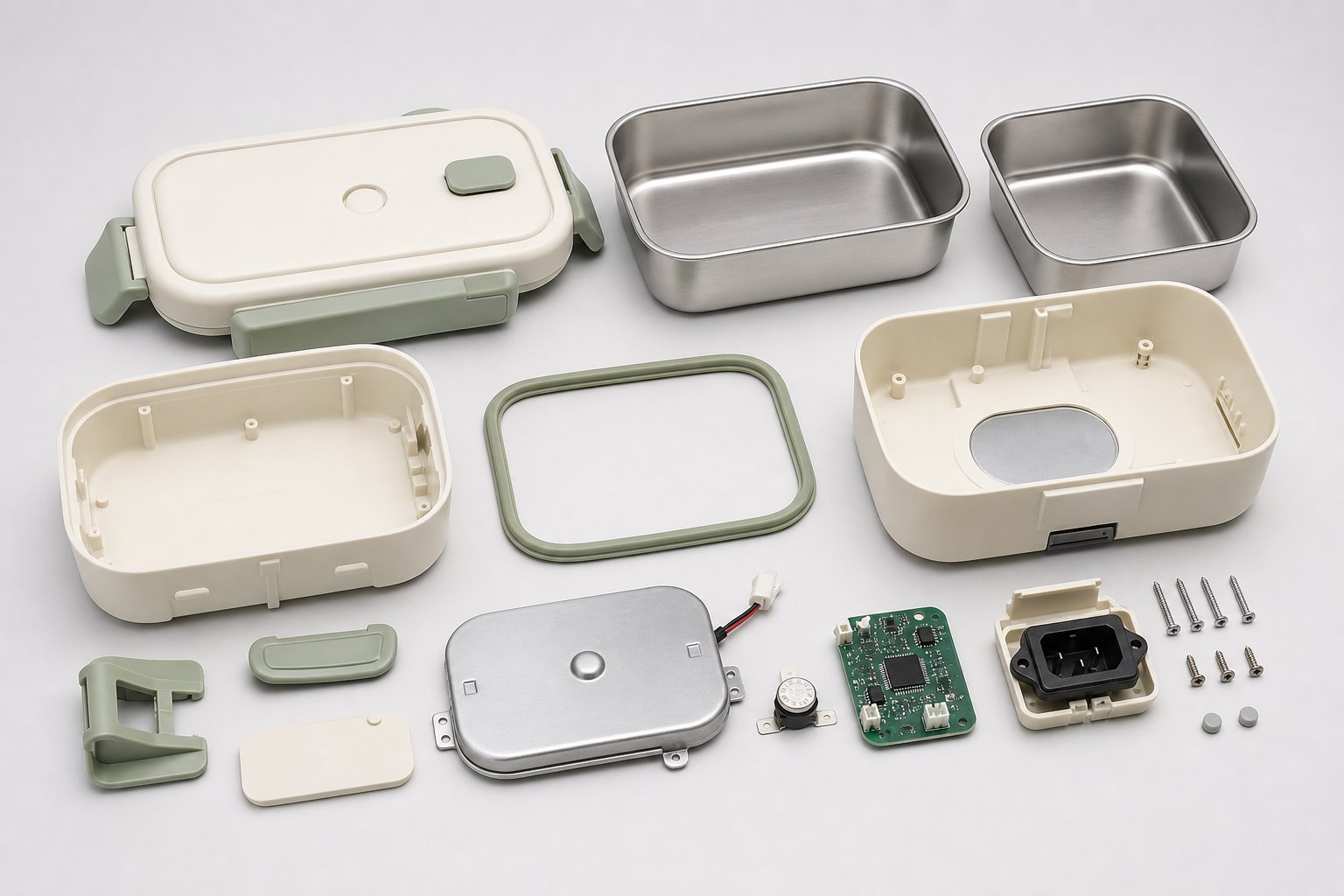
This representative home-and-kitchen project explores a product that must behave as both a storage container and a small appliance. The brand brief calls for removable stainless food trays, leak-resistant transport, simple one-button operation and a housing that remains comfortable to carry after a heating cycle.
The development scope includes industrial design, plastic enclosure DFM, stainless tray forming, silicone sealing, heater integration, thermal protection, a basic control board, line assembly and final functional testing. Because food-contact and electrical functions share the same compact enclosure, the product architecture must establish clear barriers between washable parts and powered components.
- Two removable stainless-steel food trays in different capacities
- A silicone sealing frame isolated from the heated electrical base
- Injection-molded PP housing, lid and latches
- Controlled heating plate with thermal fuse and temperature monitoring
- Detachable power connection and protected cable storage
Architecture Review – Separating the Wet Zone from the Electrical Zone
The first design decision is not color or styling; it is the boundary between the washable food container and the electrical module. The stainless trays lift out as one cleanable layer, while the heater, control board and inlet remain below a sealed structural deck. Fastener and drain paths are positioned so that ordinary cleaning cannot direct liquid toward live parts.
The lid seal controls transport leakage, but it must also release without excessive force. Latch geometry, gasket compression and tray flange height are reviewed as one tolerance chain. This prevents a common failure where every component meets its own drawing but the assembled product is either too loose or too difficult to close.
Engineering and Supplier Coordination
The project requires different suppliers for molded plastic, deep-drawn stainless trays, silicone seals and the heating-control module. We establish master interface dimensions and nominate one final assembly partner with appliance experience. Component quotes are compared with process assumptions visible, allowing the brand to understand where tooling, material and assembly costs originate.
Before production tooling, prototypes are used to validate handle balance, tray removal, latch feel, cable storage and heat distribution. The electrical design is then reviewed against the requirements of the intended destination market so that testing and documentation are planned before the final hardware revision.
- DFM review for food-contact surfaces, draft, ribs, bosses and latch fatigue
- Tray-forming samples checked for flange flatness and nesting consistency
- Gasket cross-section trials to balance sealing and closure force
- Thermal mapping across the heating plate and tray base
- Assembly risk review covering wiring routes, strain relief and fastener control
Critical Development Challenges
Even Heating without Hot Spots
The heater is matched to the tray footprint and supported by a heat-spreading plate. Prototype measurements compare center, edge and corner temperatures under repeatable loads. Control logic and thermal protection are tuned around safe operation rather than a visually impressive but unstable heat-up time.
Leak Resistance with Removable Trays
A removable system introduces additional interfaces. We control tray flange flatness, gasket compression and latch travel, then test the complete packed product in several orientations. The electrical base is not marketed as washable; clear construction and user instructions reinforce the intended cleaning method.
Keeping the Housing Comfortable to Carry
Internal air gaps, insulating features and handle placement are reviewed together. The handle attachment points transfer load into structural ribs rather than cosmetic walls, while touch-point temperatures are measured after representative heating cycles.
Assembly Control and Verification
Incoming inspection covers food-contact material declarations, tray dimensions, gasket condition and electrical component identity. The assembly line uses controlled fastener settings, wiring fixtures and visual checks for thermal-fuse placement and strain relief.
Every unit follows a defined functional sequence: power-on indication, heating response, control operation and a safety check. The sampling plan adds leakage, latch cycling, handle-load, drop and carton tests. Any compliance certification remains a separate formal process with accredited laboratories for the destination market; the manufacturing file is prepared to support that work.
Outcome – A Controlled Handoff for Appliance Manufacturing
The representative outcome is a production-ready package of drawings, approved components, assembly instructions, functional-test steps and inspection criteria. Instead of treating the lunch box as one supplier's black-box product, the brand can see and control its critical food-contact, thermal and electrical decisions.
The modular platform also creates room for future variants, including alternative tray layouts, colorways or market-specific power modules, while maintaining the mechanical architecture and quality checkpoints already validated.
How IFBrand Sourcing Supports Similar Projects
A project like this connects several disciplines. IFBrand Sourcing can support product design and DFM, supplier sourcing and factory evaluation, mass manufacturing management, and shipping and warehousing coordination. Visit our end-to-end process or contact the team to discuss a product brief.