A Case Study in Plastic Engineering, Multi‑Supplier Sourcing & Complete Assembly
Project Overview – From a Single Sketch to a Ready‑to‑Ship Product
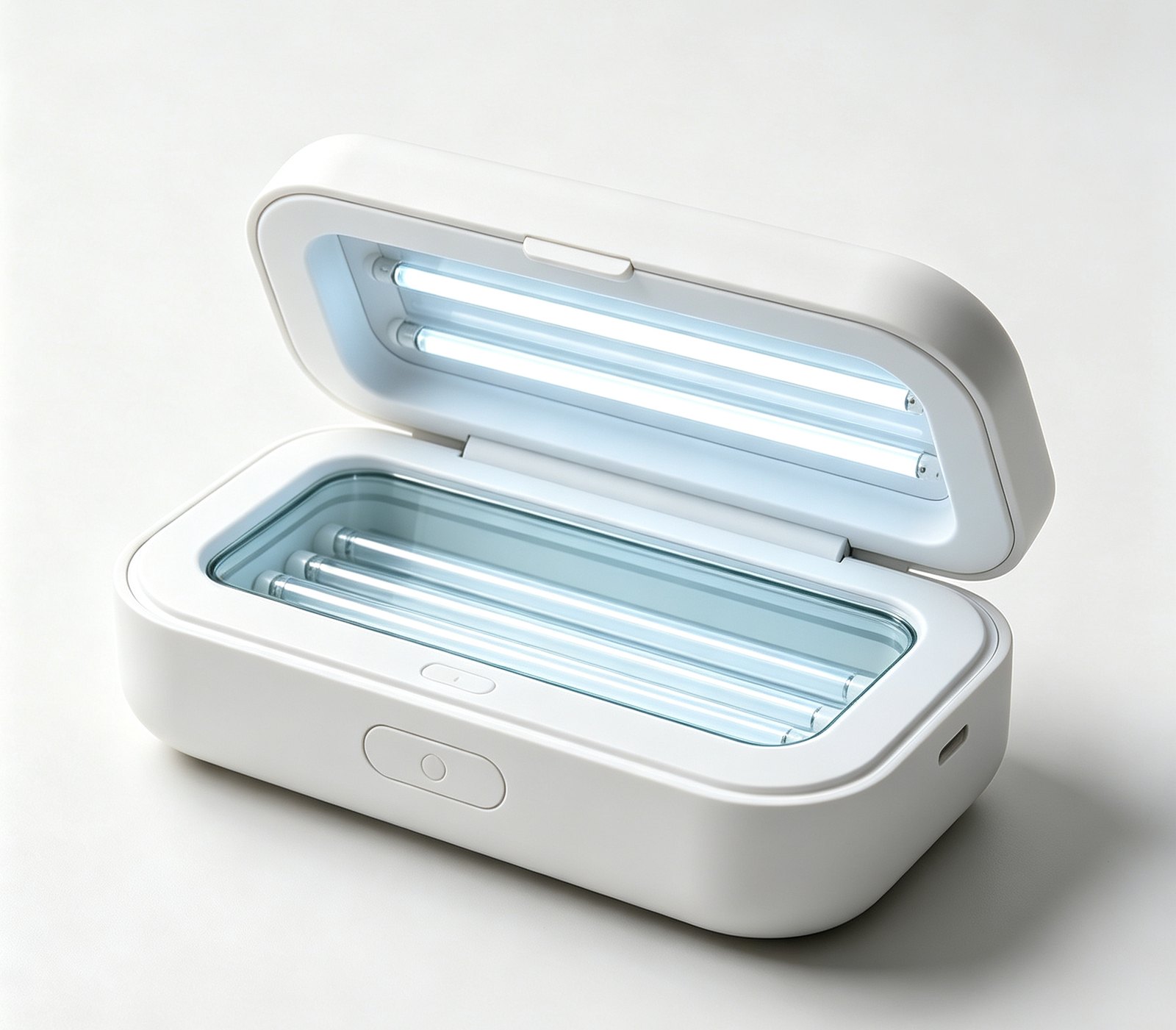
A US‑based e‑commerce brand envisioned a custom UV sterilizer box for personal care items, but they had only:
- A single 2D concept image (one perspective)
- Approximate external dimensions
- A reference photo of a similar product
No internal structural drawings, no detailed specifications for the electronics, lamp, or glass. The brand needed us to take this raw concept and deliver a fully engineered, manufactured, and assembled product—ready for their online launch, with no further development work on their side.
The product comprises:
- Custom plastic enclosure (top/bottom shells, lid with hinge)
- UV‑C lamp tube (custom specification)
- Printed circuit board (PCB) with Hall‑sensor switch
- Quartz glass plate (for the internal tray, ensuring high UV transmission)
Our scope went beyond plastics: we also took full responsibility for final assembly, including electronic component sourcing, wiring, and functional testing.
Our Engineered Solutions – Tackling 6 Critical Challenges
🔹 Challenge 1 – Zero Internal Structure, Starting from a Single Image
The problem: With only a visual reference and rough size, we had no mechanical data to quote or tool.
Our approach:
- Conducted benchmarking against the reference product to estimate wall thickness, draft angles, and parting lines.
- Developed an initial 3D CAD model based on the client’s visual ID, then iteratively refined internal ribs, bosses, and screw posts to accommodate the electronics and lamp.
- Simultaneously sourced and vetted multiple injection‑moulding factories:
- Obtained competitive quotations;
- Visited shortlisted factories to discuss manufacturability (DFM) and suggest design adjustments;
- Performed onsite audits with photo/video documentation, assessing equipment, quality systems, and past similar projects.
- Presented a detailed feasibility report and a tooling‑cost range to the client, securing approval before moving to full development.
🔹 Challenge 2 – Integrating 3 Custom‑Sourced Components (PCB, Lamp, Quartz Glass)
Each of these parts came from different suppliers, each with its own tolerances. The plastic enclosure had to accommodate all of them while maintaining proper fit, function, and safety.
Our solution:
- Defined clear interface dimensions for the PCB mounting, lamp holder clips, and glass support ribs.
- Incorporated adjustable snap‑fit features and locating pins to compensate for supplier tolerances.
- Designed the quartz glass tray with reinforced edges and a rubber cushion to distribute load, ensuring breakage‑proof support during normal use—while preserving maximum UV‑C transmittance.
- Optimised the internal wiring channel so that cable routing would not interfere with the UV lamp’s radiation pattern or the Hall‑sensor’s magnetic field.
All structural dimensions were cross‑checked with each vendor’s sample data before final mould steel cutting.
🔹 Challenge 3 – Hall‑Sensor Button: Ergonomic Feel & Tactile Response
The lid open/close is controlled by a Hall‑effect switch triggered by a magnet in the lid. The physical button on the exterior needed to provide comfortable, responsive feedback to the user.
Our work:
- Designed the button stroke and spring force based on human‑factor analysis;
- Produced multiple prototype buttons with different tactile profiles;
- Tested with a panel of users to finalise a click‑feel that is neither too stiff nor too mushy.
🔹 Challenge 4 – Hinge & Magnet Alignment: Finding the Perfect Balance
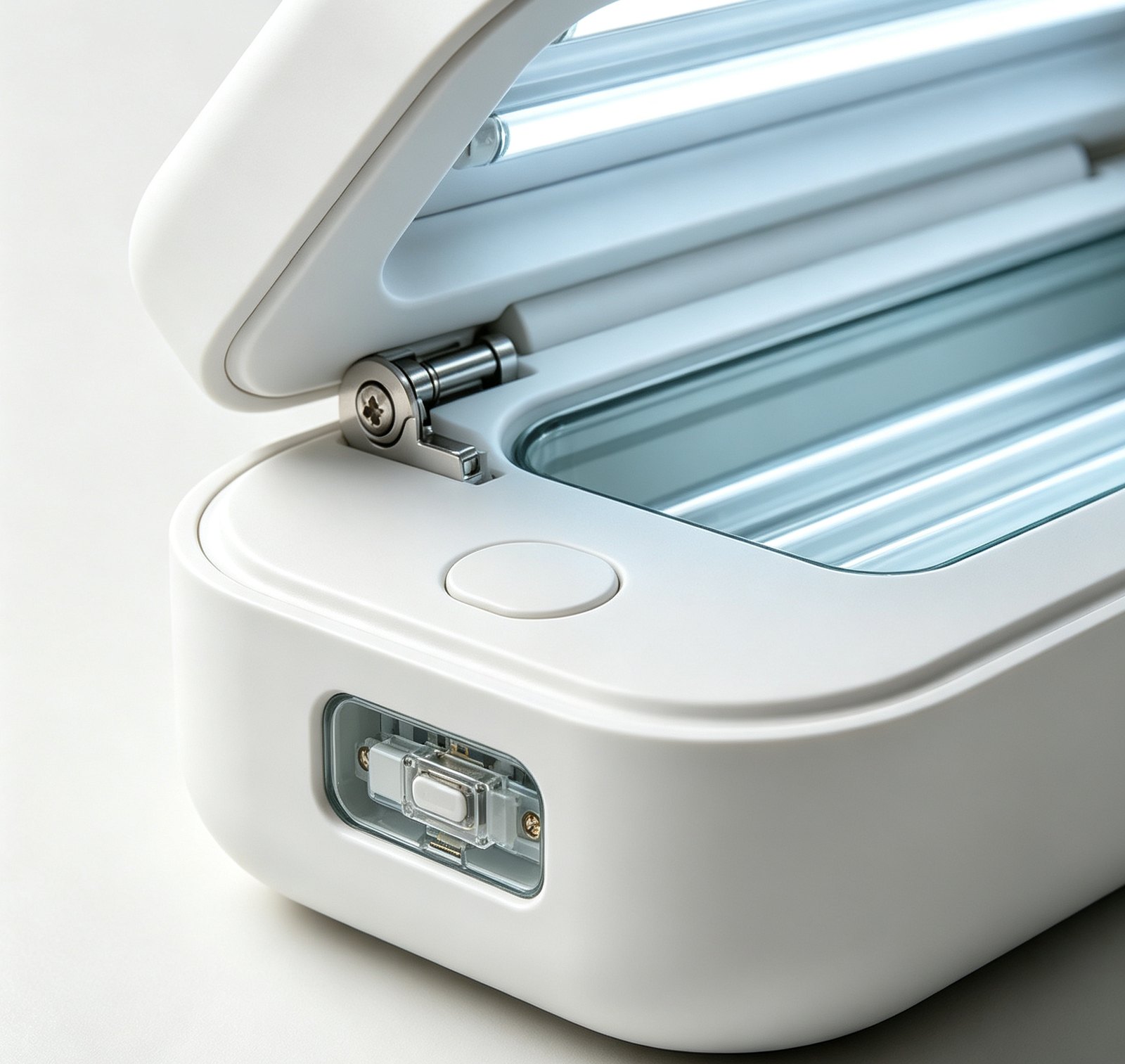
The lid’s hinge mechanism and the magnet placement for the Hall sensor had to work in harmony. If the hinge was too loose, the lid would not stay open; if too tight, it would be hard to operate—and the magnet misalignment could cause the switch to trigger erratically.
Our solution:
- Designed an adjustable hinge using different torque‑rated torsion springs.
- Conducted systematic testing with springs of varying forces, measuring the opening/closing angle and the magnetic trigger point.
- Settled on a balanced torque value that keeps the lid stable at any angle while ensuring the Hall sensor reliably detects the magnet’s presence—verified through 500+ open‑close cycles.
🔹 Challenge 5 – Soft‑Touch Coating: Durability & Colour Accuracy
The external shell required a soft‑touch paint for a premium feel, but this surface is prone to scratching during everyday use.
Our approach:
- Partnered with a coating specialist to evaluate abrasion‑resistant soft‑touch formulations.
- Tested multiple paints using scratch‑resistance (pencil hardness) and adhesion (cross‑cut) tests.
- Matched the client’s specified Pantone colour through multiple colour‑mixing trials, ensuring batch‑to‑batch consistency.
- Validated that the coating does not interfere with UV‑C transparency or sensor performance (no outgassing).
🔹 Challenge 6 – Full Assembly & Two‑Mode Functional Validation (NEW)
Our scope included complete assembly—not just supplying parts. The sterilizer features two distinct disinfection modes, activated by long‑press and short‑press of the same button. This dual‑mode operation demands precise electronic behaviour and reliable user interaction.
We established a robust assembly process to guarantee functionality:
- Incoming quality control (IQC) for all electronic components (PCB, lamp, button) and wiring—checking for defects, correct ratings, and solder integrity.
- Detailed Standard Operating Procedures (SOPs) for each assembly step, covering:
- Wire routing and adhesive tape placement to secure cables firmly in designated channels, preventing movement that could affect the Hall sensor or create electrical shorts.
- Lamp installation with correct orientation and secure clips.
- Quartz glass placement with proper cushioning and clearance.
- In‑process checks during assembly to catch any misalignment or loose connections before final closure.
- Final functional tests simulating real‑user scenarios:
- Short‑press → Mode 1 (e.g., quick 3‑minute cycle)
- Long‑press → Mode 2 (e.g., extended 10‑minute deep‑cleaning cycle)
- Verified that both modes start/stop correctly, the UV lamp operates at the right intensity, and the timer and indicator lights respond as programmed.
We also performed drop tests on fully assembled units to ensure the wiring and glass remain secure under shipping conditions.
Outcome – A Complete, Certified, Ready‑to‑Sell Product
This project vividly illustrates our capability as a full‑service sourcing partner that excels in:
- Plastic enclosure design & tooling – from a mere sketch to production‑ready moulds;
- Multi‑vendor coordination – seamlessly integrating custom PCBs, lamps, and quartz glass;
- User‑centric engineering – ensuring tactile comfort, hinge durability, and scratch‑resistant finishes;
- End‑to‑end assembly & quality control – managing all final assembly, wiring, and functional testing to deliver a fully operational, consumer‑ready unit.
The client received their first production batch on schedule, with every unit passing our dual‑mode functional tests. The validated assembly SOPs and supplier quality controls now support hassle‑free reorders—giving the brand a reliable supply chain and a competitive edge in the personal‑care electronics market.
Need help developing a similar product? Explore our product design, product sourcing and mass manufacturing services, or contact IFBrand Sourcing to discuss your project.