The Client Challenge – A Nordic Personal Care Brand’s Quest for Uniform Soft‑Touch Feel
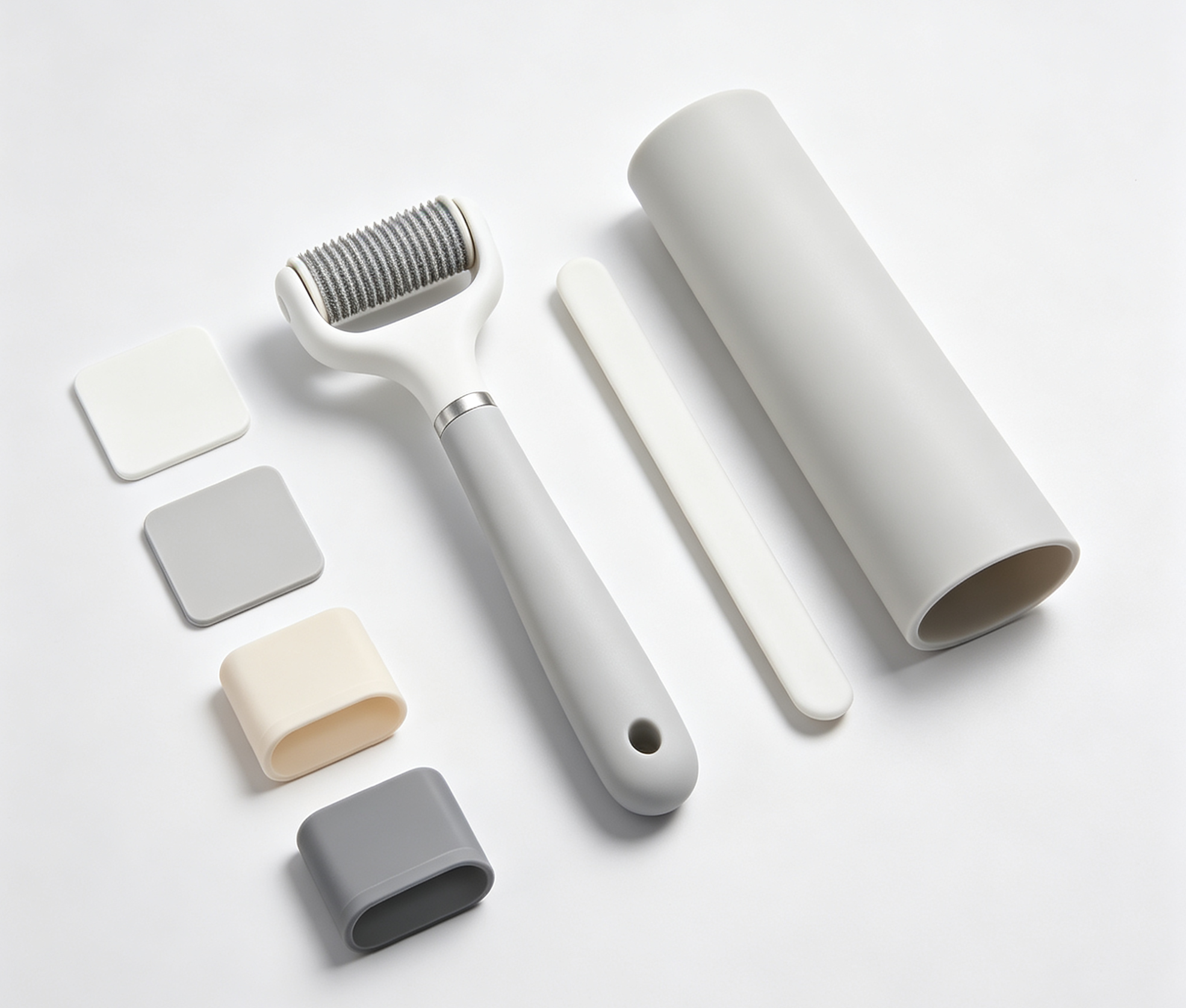
A well‑known Nordic personal care brand approached us with a critical need. They were in the process of relocating their derma roller production to a new factory, which meant the entire plastic enclosure system—the handle and the storage case (the shell that holds the roller head)—had to be re‑tooled from scratch.
Their existing products used:
- Storage case: pure ABS (hard plastic)
- Handle: soft‑touch over‑molded plastic (rubber‑like feel)
For the new version, the brand wanted both the handle and the storage case to have the same soft‑touch hand feel—a unified tactile experience across the entire product line.
However, their current supplier could only produce the handle with a soft‑over‑hard over‑molding process. They were unable to apply the same technique to the storage case due to its larger diameter. The brand came to us for a solution.
Our Initial Findings – Uncovering the Real Bottlenecks
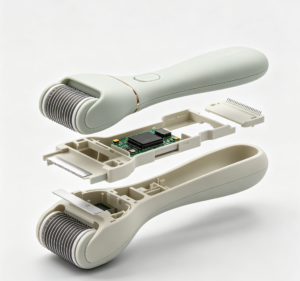
We conducted a thorough assessment and identified three critical issues:
- Equipment limitation at the client’s existing factory
The supplier’s injection‑molding machines were designed for small‑sized components and could not handle the large‑diameter storage case required for over‑molding. This was the fundamental reason they couldn’t deliver the uniform soft‑touch case. - Color consistency risk across two separate production lines
If we kept the handle at the original factory and produced the case with a new partner, we would face a high risk of batch‑to‑batch color mismatch—especially critical because the product comes in four different color SKUs. The client explicitly needed identical shades between handle and case. - Two technical paths – with very different cost structures
Our research revealed that the desired soft‑touch finish could be achieved via either:- Over‑molding (insert molding): Lower tooling cost, but higher piece price because it requires manual insertion of the hard substrate into the mold, leading to longer cycle times and some tolerance variability.
- Double‑shot (two‑shot) molding: Higher tooling investment, but fully automated, with extremely tight tolerances and much higher production efficiency—resulting in a lower unit cost at scale.
Our Engineered Solutions – Material, Process & Risk Control
🔹 Unified Responsibility – Guaranteeing Color Consistency
Instead of splitting production between two factories, we took full ownership of both components—the handle and the storage case. This allowed us to:
- Source the same raw material batch for both parts;
- Use a single color‑mixing and injection‑molding protocol;
- Eliminate any visual difference across the 4 color variants, ensuring brand‑perfect matching.
🔹 Process Selection – Double‑Shot Molding for Long‑Term Value
We presented the client with a detailed cost‑benefit analysis comparing over‑molding vs. double‑shot molding, factoring in:
- Tooling amortization
- Per‑unit production cost
- Expected order volume and frequency
The outcome: The client chose double‑shot molding, because:
- Despite a higher upfront tooling cost, the unit price remains consistently low;
- The break‑even point is reached after just 6 orders;
- Tolerances are minimized (critical for the tight fit with the internal electronics);
- Production speed is significantly higher, supporting future demand spikes.
🔹 Tactile Validation – Silicone Replica Samples for Hardness Selection
The client needed to physically feel and compare different softness levels before committing to the final hardness.
We used silicone replica molding (a low‑cost, quick‑turn technique) to produce sample sets with three different shore hardness values, mirroring the original product’s color and texture. The client evaluated them and selected the optimal feel—ensuring the final molded parts would match their ergonomic expectations.
🔹 Structural Compatibility – Early Coordination with the Finished‑Goods Supplier
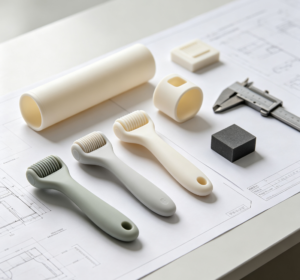
Since the derma roller is an assembled product with internal electronic components, the plastic housing must accommodate the inner mechanism with precision. Any misalignment could cause assembly failures or require costly mold modifications.
Our approach:
- We provided preliminary 3D CAD drawings to the finished‑goods supplier before mold steel was cut;
- We conducted face‑to‑face meetings with their engineering team to review fit, clearance, and assembly sequences;
- We produced functional prototypes (using the silicone replicas) and test‑fitted them with actual internal parts, identifying and resolving interference issues early.
This proactive collaboration eliminated the risk of scrapping or major rework after tooling—saving both time and budget.
Outcome – A Cost‑Efficient, Risk‑Free Plastic Solution
This project demonstrates our core competency in plastic material engineering:
- Raw material control – unified batch sourcing ensures color consistency across all SKUs.
- Process expertise – we guided the client to the most economical molding method (double‑shot) for their order volumes, balancing upfront investment with long‑term savings.
- Surface finish & tactile quality – we validated hardness through real samples, guaranteeing the desired soft‑touch experience.
- Risk mitigation – we coordinated with the end‑assembly supplier early, avoiding post‑tooling modifications.
The client now has a reliable, scalable plastic solution for both handle and case, with consistent color, premium feel, and tight tolerances—all while keeping total cost of ownership under control.
Looking for a sourcing partner who can navigate complex plastic material choices, surface treatments, and process risks—while ensuring color harmony across multiple SKUs? Let’s talk.