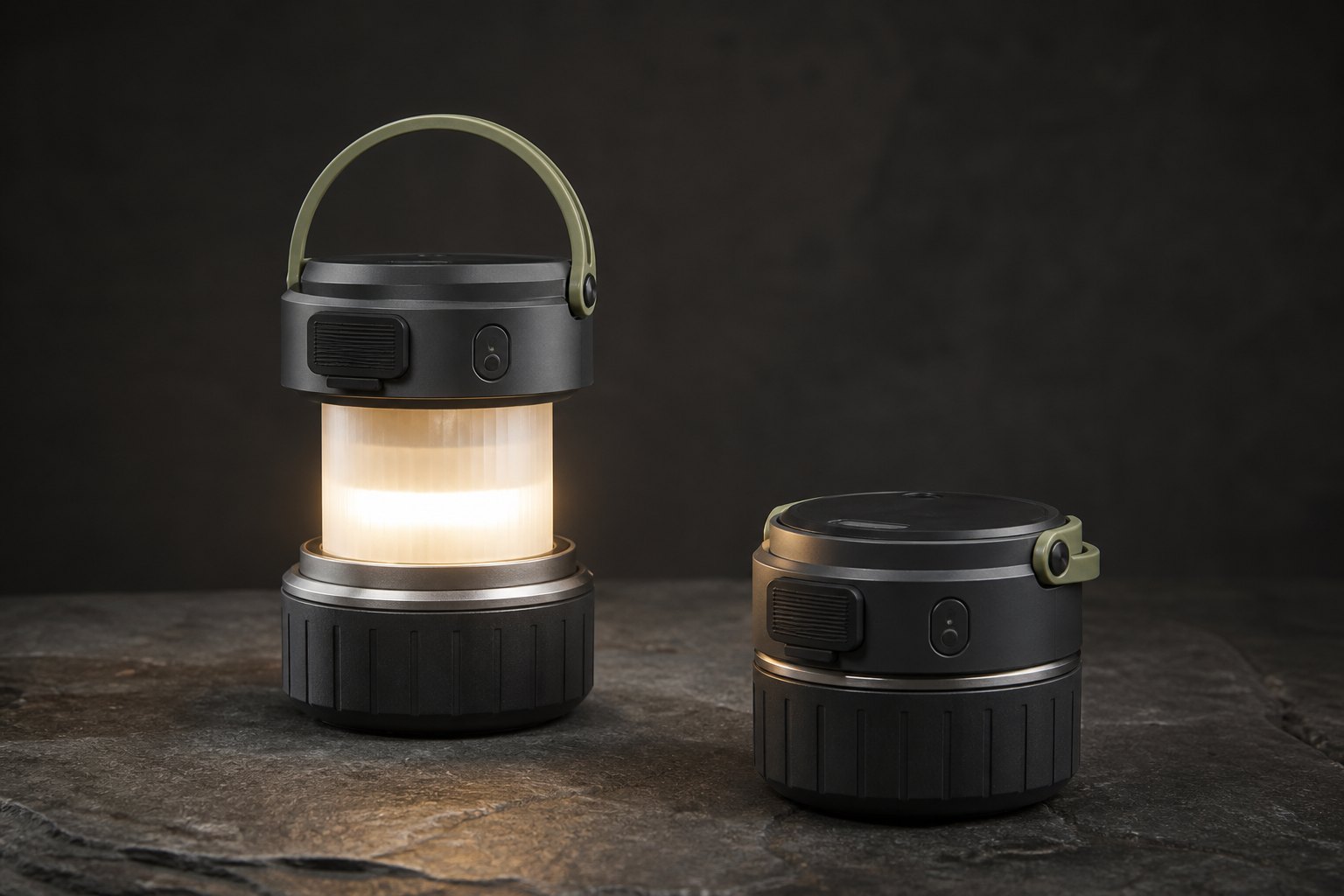
Representative Case Study: this scenario illustrates how IFBrand Sourcing manages comparable product-development and manufacturing requirements. Client identity and commercially sensitive details are intentionally anonymized.
Project Overview – Combining Light, Power and Packability
This representative outdoor-electronics case starts with a compact product brief: create a lantern that stores at a low height, extends into a broad area light, provides a protected emergency charging output and feels robust enough for repeated travel. The product must balance battery capacity, useful light, thermal control, sealing and carry comfort inside one small enclosure.
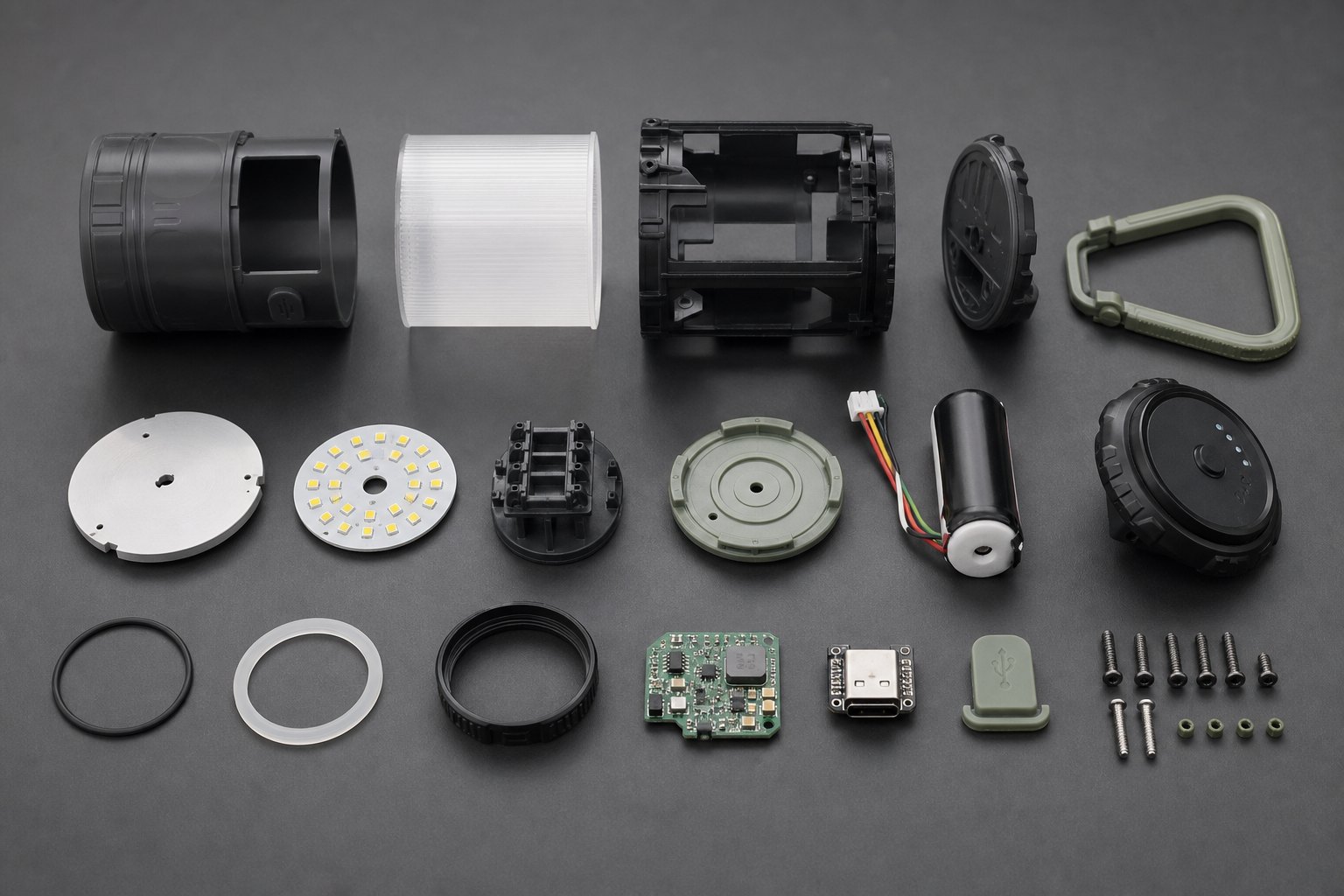
The scope covers industrial design, PC-ABS enclosure engineering, translucent diffuser development, an aluminum heat spreader, LED and control electronics, a protected battery pack, silicone port seals, the foldable handle, final assembly and functional verification.
- Telescoping diffuser that protects itself in the closed position
- Warm multi-level LED illumination with a simple control sequence
- Protected rechargeable battery pack and emergency USB output
- Covered charging and output ports with replaceable silicone seals
- Foldable handle designed for carrying and hanging loads
System Architecture – Mechanical Movement around Sensitive Electronics
The telescoping light chamber is the defining feature and the main mechanical risk. It must move smoothly without rattling, remain extended during use and avoid pinching wires or seals. We separate the moving diffuser from the fixed electronics module, then define stops and guide features that control travel without relying on fragile cosmetic walls.
The battery and PCB sit inside a protected lower compartment. The LED board connects to an aluminum heat spreader, while the diffuser receives enough distance and texture to blend individual LED points into an even light. Port covers and housing joints are treated as serviceable sealing interfaces rather than decorative details.
Product Design, Sourcing and DFM
The enclosure is reviewed for draft, impact ribs, screw-boss strength and sealing-groove consistency. A textured PC-ABS grade is selected for the main body, with a separate translucent material for the diffuser. The foldable handle uses reinforced pivots and a load path that transfers force into the structural frame.
Electronics sourcing verifies the battery pack, protection circuit, LED bin, charging components and connectors as one controlled bill of materials. Approved alternates are evaluated before production rather than introduced silently during a shortage.
- Optical prototypes to compare diffuser texture and LED spacing
- Thermal measurements at the LED board, spreader, battery and user touch points
- Handle pivot samples with repeated folding and static-load checks
- Sealing stack review for housing joints, control button and port cover
- Battery and electronics records prepared for destination-market testing and shipping documents
Critical Challenges and Solutions
Uniform Light without Excessive Heat
LED count alone does not determine product quality. We test LED spacing, drive current, diffuser distance and surface texture together. The aluminum spreader moves heat away from the board, and firmware settings are selected using measured thermal behavior rather than maximum theoretical output.
Reliable Telescoping Movement
Guide rails use controlled clearances and broad contact surfaces to resist wear. End stops are reinforced, and the closed position prevents the diffuser from carrying impact loads directly. Cycle samples are checked for looseness, binding and cosmetic rubbing.
Sealed Ports that Users Can Actually Open
A port cover must compress its seal without requiring tools. We tune silicone hardness, hinge geometry and pull-tab size, then test retention after repeated opening. The cover is replaceable so that a damaged accessory does not require discarding the complete lantern.
Assembly, Functional Testing and Shipping Readiness
Assembly controls include battery identity checks, connector seating, wire routing, fastener settings, seal inspection and diffuser movement. The functional sequence verifies charging, each lighting mode, indicator behavior, output-port operation and protective shutdown.
Sampling adds runtime measurement, thermal monitoring, handle load, telescoping cycles, drop tests and water-exposure checks against the product's defined design target. Lithium-battery transport and market compliance are handled through the appropriate test reports and shipping documentation; the case study does not treat generated product imagery as proof of certification.
Outcome – A Transparent Turnkey Manufacturing Package
The representative outcome is a complete handoff connecting enclosure drawings, optical and thermal decisions, an approved bill of materials, battery records, assembly instructions and final test limits. The brand can understand which features drive cost and risk, rather than receiving only a finished sample and a bundled price.
Because the mechanical and electrical interfaces are documented, future versions can add different battery capacities, diffuser heights or colorways while keeping supplier qualification and core quality controls consistent.
How IFBrand Sourcing Supports Similar Projects
A project like this connects several disciplines. IFBrand Sourcing can support product design and DFM, supplier sourcing and factory evaluation, mass manufacturing management, and shipping and warehousing coordination. Visit our end-to-end process or contact the team to discuss a product brief.