
Introduction
Industrial designers create stunning digital product renders continuously. Hardware startups secure millions in venture capital using these beautiful 3D concepts. However, these digital models frequently fail on the actual factory floor. You cannot mass-produce an impossible geometry using standard industrial machinery. Executing proper design for manufacturing China prevents this catastrophic hardware failure completely. Inexperienced designers ignore complex metallurgical and thermodynamic manufacturing constraints entirely. They design vertical plastic walls that trap themselves inside steel molds permanently. They specify impossible CNC machining angles that destroy expensive cutting tools instantly.
Failing to execute a strict engineering review destroys your hardware startup instantly. Factories will happily cut an expensive steel mold based on your flawed digital file. When the first plastic parts emerge warped and unusable, the factory blames your original design. You lose tens of thousands of dollars in ruined tooling capital. You miss your critical seasonal retail launch window entirely. You bleed venture capital while engineers scramble to redesign the core product geometry.
You must bridge this mechanical gap perfectly before you cut any tool steel. You require a dedicated engineering team that understands high-volume production physics intimately. This technical guide deconstructs the exact mechanics of DFM engineering. We analyze critical draft angles, thermodynamic wall thicknesses, and advanced robotic assembly constraints. We reveal how optimizing your CAD files guarantees absolute mass manufacturing success.
Bridging Concept and Mass Production
Digital CAD software represents theoretical mathematical perfection exclusively. Physical factory machines operate within strict physical and kinematic limitations. We must translate your digital concept into a viable physical object. We engineer your digital geometry to survive the brutal physical reality of industrial mass production.
Analyzing Draft Angles
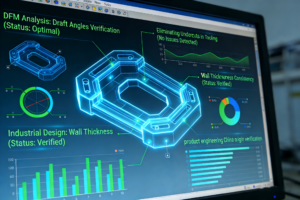
Solid plastic shrinks violently as it cools inside the steel mold cavity. The shrinking plastic grips the rigid steel core incredibly tightly. Pneumatic ejection pins cannot push the part out if the walls remain perfectly vertical. We engineer precise draft angles into every single vertical surface. A mathematically calculated two-degree draft angle allows the plastic to release smoothly. This critical geometric slope prevents deep surface scratches and friction drag entirely. We guarantee your plastic components eject flawlessly every single cycle.
Standardizing Fasteners and Components
Complex hardware products frequently utilize dozens of different internal screw sizes. This poor engineering choice slows down the manual factory assembly line drastically. Factory technicians waste valuable seconds swapping pneumatic screwdriver bits constantly. We standardize all internal fasteners completely during our initial engineering review. We specify a single, universal machine screw type across the entire mechanical assembly. This component standardization accelerates mass production output and lowers your total Bill of Materials (BOM) cost massively.
Eliminating Undercuts in Tooling
Inexperienced designers often include complex internal overhangs and horizontal mounting clips. Injection molds open strictly in a single, straight linear direction. Complex undercuts prevent the steel mold from opening normally. Factories must engineer expensive sliding side-actions or lifters to release these specific undercuts. These complex side-actions add thousands of dollars to your initial tooling capital. We redesign the plastic geometry to eliminate these expensive undercuts completely. We execute a flawless prototype to production transition efficiently.
Cost Reduction Physics through Engineering
Furthermore, scaling a hardware brand requires immense financial efficiency constantly. Poor mechanical design inflates your final unit cost drastically. Consequently, we leverage our deep factory expertise to dominate cost reduction. Therefore, we engineer highly favorable production geometries for our international clients. Moreover, this localized engineering eliminates massive production waste completely. Thus, we protect your profit margins directly inside the CAD software.
Reducing Wall Thickness Variables
Furthermore, uneven plastic walls create severe thermodynamic cooling issues constantly. Consequently, thick plastic sections cool much slower than thin surrounding areas. Therefore, the thick plastic shrinks unevenly, creating massive cosmetic sink marks on the exterior surface. Moreover, this differential cooling warps the entire physical chassis permanently upon ejection. Thus, we engineer mathematically uniform wall thicknesses across the entire product geometry. Consequently, the plastic part maintains perfect structural integrity and visual aesthetics. We execute advanced DFM analysis to guarantee this outcome.
Consolidating Assembly Steps
Consequently, human manual labor drives up your final unit cost significantly. Therefore, intricate assemblies requiring dozens of screws hurt your profit margins. Furthermore, we consolidate multiple individual components into single, highly complex injected parts. Moreover, we engineer secure plastic snap-fits to replace heavy metal screws entirely. Consequently, factory technicians assemble your product in seconds without utilizing any power tools. Thus, we maximize your labor efficiency and slash your final assembly costs completely.
Selecting Scalable Raw Materials
Moreover, specifying exotic aerospace materials ruins consumer product viability instantly. Therefore, we analyze your functional mechanical requirements carefully before mass production begins. Consequently, we replace expensive machined aluminum blocks with high-strength, glass-filled nylon polymers. Furthermore, this intelligent material substitution drops your unit cost by eighty percent effortlessly. Thus, you scale your hardware brand rapidly without sacrificing mechanical durability or tensile strength. You need a verified industrial design agency Shenzhen to execute this strategy.
Comparison Matrix: The Product Development Lifecycle
Mechanical engineers evaluate design goals, software utility, and factory integration constantly. They analyze comparative development phases to optimize heavy industrial product launches. The following matrix contrasts core development stages based on primary engineering goals, digital software platforms, and factory involvement:
| Development Phase | Primary Engineering Goals & Focus | Digital Software & File Formats | Factory Interaction & Tooling Impact |
| Conceptual Industrial Design | Focuses entirely on aesthetics, human ergonomics, and market appeal. Defines the visual brand language and exterior surface curvature. | Utilizes surface modeling software like Rhino, Blender, or Alias. Generates high-resolution marketing renders and visual mesh files (STL/OBJ). | Zero factory involvement. The digital model frequently contains impossible geometries, zero wall thickness data, and severe undercuts. |
| Design for Manufacturing (DFM) | Bridges the gap. Adds internal mounting bosses, draft angles, uniform wall thicknesses, and calculates thermodynamic shrinkage rates. | Utilizes parametric solid modeling software like SolidWorks, Creo, or Fusion 360. Generates mathematically perfect solid bodies (STEP/IGES). | High factory collaboration. Engineers adjust the CAD file based directly on the specific injection machine tonnage and steel mold limitations. |
| Final Mass Production Tooling | Focuses on rapid cycle times, robotic part ejection, and minimizing cosmetic defects like flash or weld lines. | Utilizes specialized CAM (Computer-Aided Manufacturing) software to program the 5-axis CNC machines that physically cut the H13 steel. | Total factory control. The factory cuts the hardened steel mold and initiates high-speed, continuous injection molding runs. |
Rapid Prototyping and CNC Machining
Executing a flawless retail product launch requires absolute physical validation continuously. Digital screens cannot simulate tactile friction or true mechanical snap-fits. We must translate the digital geometry into a physical object to verify our engineering math. We deploy rapid prototyping technologies to test every single mechanical variable. We eliminate costly theoretical assumptions entirely before committing to mass production.
Validating Mechanical Tolerances
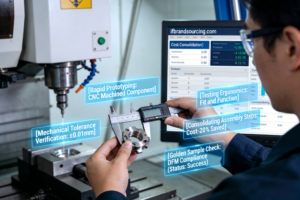
Physical manufacturing introduces microscopic dimensional variations continuously across the assembly line. We cannot guess if two separate plastic halves will snap together tightly. We utilize high-speed CNC machines to carve physical prototypes directly from solid ABS plastic blocks. We verify the precise mechanical fitment and dimensional clearances perfectly using these physical models. We discover microscopic interference issues immediately. We adjust the digital CAD tolerances to eliminate these assembly failures entirely.
Testing Ergonomics
Consumer electronics must feel comfortable and balanced in the human hand always. Digital screens cannot simulate physical weight distribution or grip texture accurately. We 3D print high-resolution ergonomic models utilizing advanced Stereolithography (SLA) resin printers. We test the button placement and surface curvature thoroughly with real human users. We refine the exterior industrial design based entirely on this direct physical feedback. We guarantee your final product delivers an exceptional user experience.
Iterating Before Steel Tooling
Hardened steel injection molds cost tens of thousands of dollars to manufacture. You cannot easily modify the steel cavity once the factory cuts the heavy metal. Rapid prototyping allows us to iterate the mechanical design extremely cheaply and rapidly. We discover structural flaws using cheap CNC models instead of expensive steel tooling. We lock in the final design only after achieving absolute physical perfection. We provide elite product engineering China services globally.
Frequently Asked Questions (FAQ)
- What CAD file formats do Chinese factories require for mass production?
Factories require parametric solid bodies, not hollow visual meshes. You must provide STEP (.stp) or IGES (.igs) file formats. These mathematical files define exact geometric volumes and curves. Factories cannot manufacture physical parts using standard 3D printing mesh files like STL or OBJ.
- What is a Mold Flow Analysis and why do you execute it?
Mold Flow Analysis utilizes advanced thermodynamic simulation software before we cut the steel. The computer simulates the molten plastic flowing into the virtual mold cavity. It mathematically predicts trapped air pockets, cosmetic weld lines, and severe warping. We adjust the digital gate locations to solve these issues entirely.
- Can we overmold soft rubber directly onto hard plastic components?
Yes. We engineer advanced two-shot (2K) injection molding designs frequently. The machine injects a hard polycarbonate skeleton first. The mold rotates, and the machine immediately injects soft TPU rubber directly over the hard skeleton. This creates a permanent, chemical bond without utilizing any messy industrial adhesives.
- How do you protect my proprietary CAD files from factory intellectual property theft?
We deploy strict NNN (Non-Use, Non-Disclosure, Non-Circumvention) legal agreements before we share your STEP files. We draft these ironclad contracts in the local language under local legal jurisdiction. We compartmentalize the manufacturing data so no single factory possesses the entire final assembly blueprint.
- What is the difference between SLA 3D printing and CNC prototyping?
SLA (Stereolithography) uses UV lasers to cure liquid resin. It creates beautiful, highly detailed visual models but produces brittle parts that snap easily. CNC machining physically carves the prototype out of real engineering plastics like Delrin or ABS. CNC provides the true mechanical strength needed for rigorous functional testing.
- Does your agency provide the final 2D manufacturing technical drawings?
Absolutely. Factories require detailed 2D technical drawings (PDF/DWG formats) alongside the 3D STEP files. We generate these strict engineering blueprints. We define the critical dimensional tolerances, specific surface finish callouts (like SPI A2 polish), and precise Pantone color matching codes for the factory floor.
Conclusion
The commercial reality within the global hardware development market remains irrefutable constantly. Pushing flawed digital concepts into mass production destroys your critical venture capital instantly. You must execute your product engineering through a highly verified localized agency. We execute perfect design for manufacturing protocols that guarantee absolute mechanical success. By migrating your development to our dedicated team, you acquire flawless supply chain stability. We excel at optimizing mass manufacturing architecture completely.
Partner with an elite industrial engineering agency today to eliminate catastrophic tooling defects forever. We deliver precision mechanical oversight directly from our headquarters in Shenzhen. Secure your hardware launch with our expert industrial designers. Upgrade your entire consumer catalog utilizing our premium product design division. Contact the experts at IFBrand Sourcing and revolutionize your global hardware development cycle now.