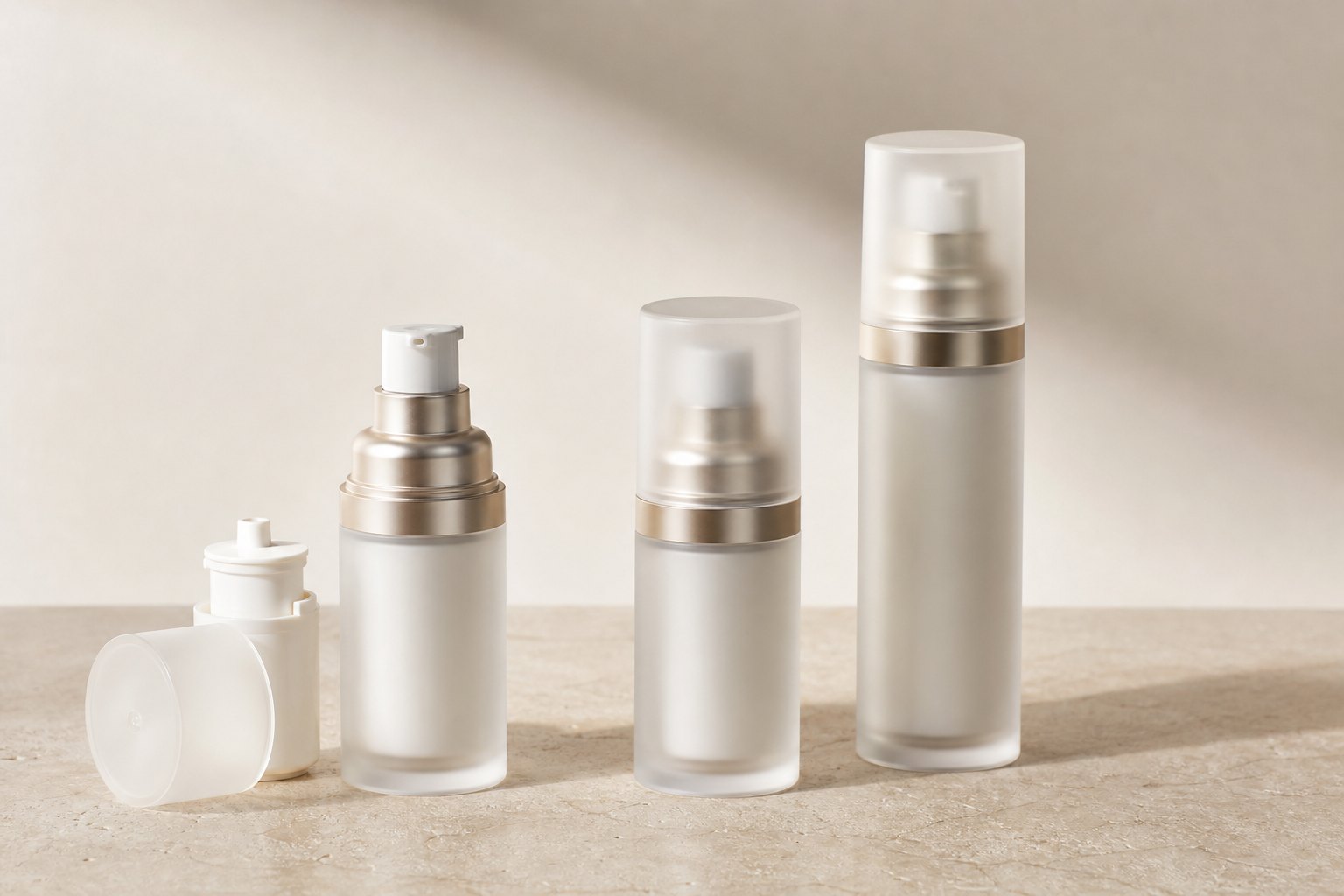
Representative Case Study: this scenario illustrates how IFBrand Sourcing manages comparable product-development and manufacturing requirements. Client identity and commercially sensitive details are intentionally anonymized.
Project Overview – A Premium Look with a Practical Refill System
This representative beauty-packaging project starts with two goals that often compete: the brand wants a premium, weighty package for its customer-facing range, but it also wants consumers to replace an inner cartridge instead of discarding the complete pump bottle. The package family must look consistent in several capacities while protecting formula contact surfaces and dispensing performance.
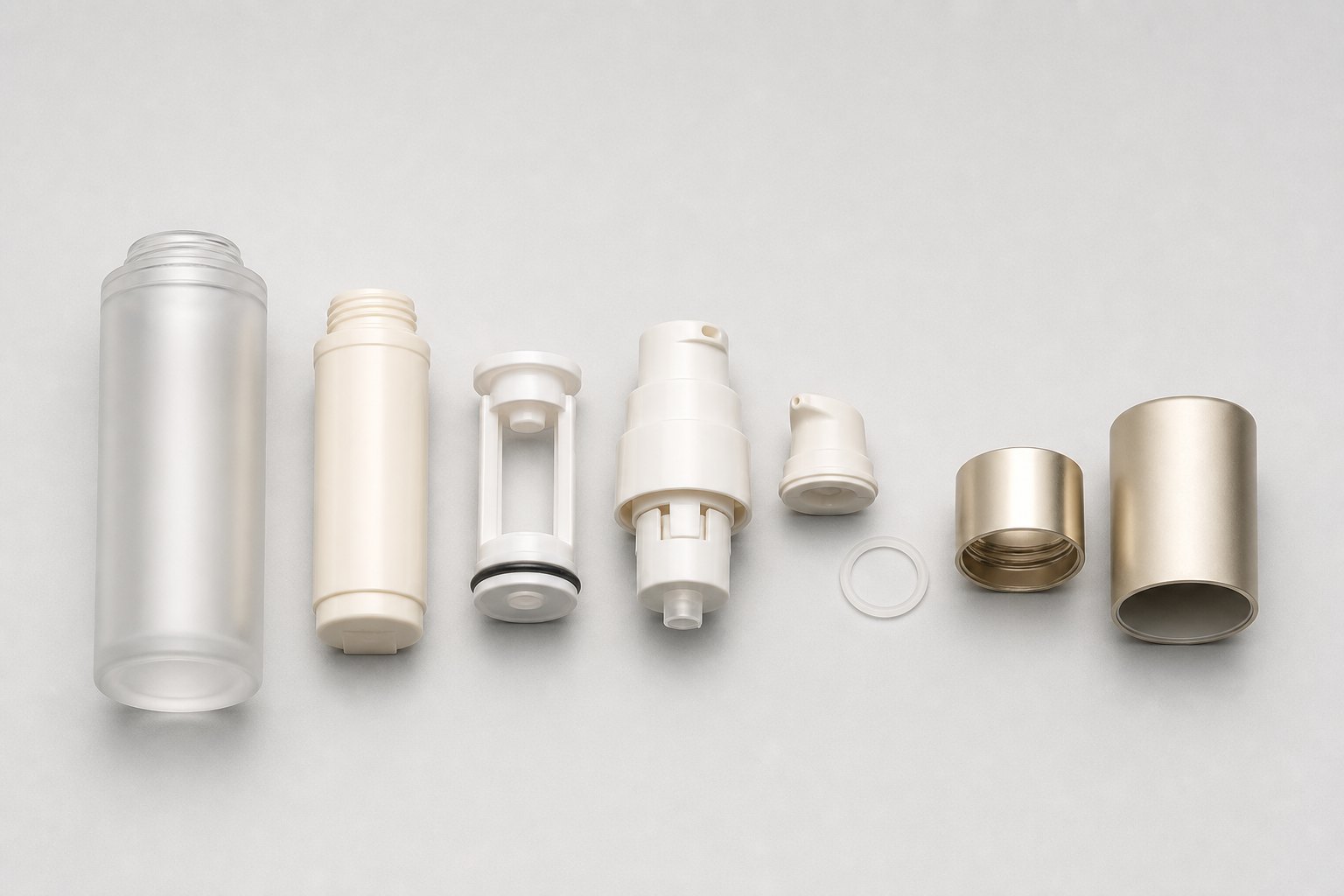
The concept combines a decorative frosted outer shell, a replaceable PP cartridge, an airless piston-and-pump engine, an actuator, a gasket, an anodized aluminum collar and a protective cap. These components involve different tooling, finishing and cleanliness requirements, making interface ownership the central sourcing issue.
- 30 ml, 50 ml and 100 ml packages with a shared design language
- Replaceable product-contact cartridge
- Airless dispensing architecture without a conventional dip tube
- Controlled frosted finish and anodized metal color
- Leak-resistant assembly and transit-ready protective packaging
Requirements Translation – From Visual Direction to Measurable Standards
Words such as premium, soft matte and smooth pump feel are not sufficient for manufacturing. We translate them into reviewable references: surface-gloss ranges, physical color masters, actuator travel, priming behavior, dosage targets, cartridge retention force and cap pull-off range. Formula-contact materials are recorded in a separate compliance file for the destination market.
The packaging brief also distinguishes fixed platform dimensions from size-specific dimensions. Pump and collar interfaces remain common wherever possible, allowing the brand to build a family without multiplying every component and tooling cost.
Supplier Architecture and Tooling Strategy
Airless pump specialists, injection molders, decorative coaters and aluminum finishers do not always operate under one roof. We identify the process owner for each component, then select one final assembly facility responsible for incoming inspection and line testing. Technical samples are exchanged before hard tooling is released so that thread, snap and sealing dimensions are based on measured parts rather than nominal drawings alone.
Tooling reviews focus on concentricity, wall thickness, visible gate locations and parting lines. The refill cartridge uses material only where it contributes to stiffness or seal performance, while the decorative shell carries the visual weight of the product.
- Shared interface drawing controlled across pump, cartridge and collar suppliers
- T1 sample review with dimensional and cosmetic findings separated
- Finish limit samples for acceptable haze, color and surface variation
- Assembly fixture concept confirmed before pilot production
- Packaging tray designed to protect pumps and anodized surfaces in transit
Critical Engineering Challenges
Reliable Airless Priming and Dosage
The pump engine is tested with representative viscosities rather than water only. We review initial priming strokes, dose consistency, piston movement and residual product behavior. Cartridge roundness and the piston sealing surface receive tighter controls than nonfunctional cosmetic dimensions.
A Refill that Feels Secure but Remains User-Serviceable
The cartridge retention system must survive drops and shipping vibration without making replacement frustrating. Snap geometry is tuned through prototype inserts, and the release action is kept separate from the pump actuator so that daily use cannot accidentally loosen the refill.
Matching Frosted Shells and Anodized Collars
Frosted coatings and anodized aluminum respond differently to light. Approval is therefore based on the complete assembled package under defined lighting. Coating adhesion, rub resistance and compatibility with assembly fixtures are checked before the cosmetic standard is frozen.
Pilot Assembly and Quality Validation
The pilot run is used to validate more than tooling. It confirms component cleaning, handling, pump insertion depth, collar torque or snap seating, cap fit and finished-product appearance. Line instructions include photographs of correct and incorrect assembly states.
The quality plan covers incoming component checks, in-process pump verification, leak and vacuum tests on an agreed sampling basis, actuator cycling, drop checks and final cosmetic inspection. Batch records connect pump lots, cartridge lots and finishing lots so that any future issue can be traced efficiently.
Outcome – A Scalable Packaging Family rather than a One-Off Bottle
The representative outcome is a documented packaging platform that can be expanded without redesigning every interface. The brand gains a common pump architecture, controlled refill fit, aligned surface standards and packaging instructions for several capacities.
This approach also supports future commercial decisions. New finishes, cap designs or outer shell shapes can be evaluated against a stable functional core, allowing the brand to refresh its appearance while protecting dispensing performance and supplier continuity.
How IFBrand Sourcing Supports Similar Projects
A project like this connects several disciplines. IFBrand Sourcing can support product design and DFM, supplier sourcing and factory evaluation, mass manufacturing management, and shipping and warehousing coordination. Visit our end-to-end process or contact the team to discuss a product brief.