
Introduction
The rise of Amazon FBA, Shopify, and eBay has created an unprecedented opportunity for entrepreneurs and established brands alike: the ability to build a profitable product line without owning a single factory. At the heart of this model is private label sourcing from China — the practice of manufacturing generic or customized products in China and branding them as your own. For thousands of successful e-commerce sellers across Amazon, Shopify, AliExpress storefronts, Alibaba wholesale channels, and eBay, China remains the world’s most cost-effective and capability-rich manufacturing hub.
Yet despite the opportunity, many first-time importers make costly mistakes. They choose the wrong supplier, skip quality inspections, underestimate lead times, or fail to differentiate their packaging. This guide walks you through every stage of sourcing private label products from China — from concept validation to delivery at your Amazon FBA warehouse or Shopify fulfillment center.
What Are Private Label Products?
Private label products are goods manufactured by a third-party factory — typically in China — but sold under a buyer’s own brand name and packaging. The buyer does not own the manufacturing facility; instead, they work with a supplier to customize an existing product or develop a new one, then apply their own branding, logo, and packaging.
This model is distinct from dropshipping, where you never handle inventory, and from wholesale reselling, where you sell another brand’s products. With private labeling, you own the brand identity and control the customer experience from unboxing to repeat purchase. This makes it especially powerful for building long-term value on platforms like Amazon, Shopify, and eBay, where brand recognition increasingly drives repeat sales and review velocity. Many brands also use Alibaba as a B2B wholesale channel alongside their D2C Shopify store — a multi-channel strategy that maximizes revenue per SKU.
Why China Remains the World’s Top Private Label Manufacturing Hub
China manufactures approximately 28% of global goods by value, and its share of private label consumer goods is even higher in categories like electronics, homeware, cosmetics, and sporting goods. Several structural advantages keep China at the top:
| Factor | China’s Advantage |
| Manufacturing ecosystem | Deep supplier networks in every major product category |
| Labor & production costs | 40–70% lower than Western alternatives for most goods |
| Raw material access | Domestic availability of plastics, metals, textiles, and electronics components |
| MOQ flexibility | Many factories accept trial orders of 100–500 units |
| Speed to market | 30–60 day production cycles for most consumer products |
| Customization capability | Color, material, logo, packaging, and feature adjustments |
Cities like Shenzhen, Guangzhou, Yiwu, and Ningbo have entire industrial districts dedicated to specific product categories, allowing a sourcing agent to quickly identify multiple qualified suppliers for any given product.
Step-by-Step Guide to Sourcing Private Label Products from China
Step 1: Define Your Product and Market
Before contacting any factory, you need a clear product brief. This includes target selling price, estimated order quantity, desired materials, functional requirements, and regulatory standards for your target market (e.g., CE for Europe, FCC for the US, or FDA compliance for food-contact items). Brands selling on Amazon must also consider ASIN category requirements and FBA dimension limits. Sellers building a Shopify DTC brand should factor in unboxing experience and packaging differentiation from day one.
Successful private label entrepreneurs typically validate demand first — using tools like Jungle Scout, Helium 10, or Google Trends — before investing in inventory. A product with 1,000+ monthly searches and fewer than 100 competing ASINs presents a realistic launch opportunity.
Step 2: Find and Evaluate Suppliers
Platforms like Alibaba, Made-in-China, and Global Sources list hundreds of thousands of Chinese manufacturers. However, not all are equally capable or trustworthy. A structured supplier evaluation process should assess:
- Business license and export qualification
- Years in operation and production scale
- Existing client references and certifications (ISO, CE, RoHS, etc.)
- Capacity to handle your MOQ and delivery timeline
- Communication responsiveness and English proficiency
Working with a professional China sourcing agent like IFBrand Sourcing dramatically reduces the risk of this step. Our agents conduct on-site factory audits, verify certifications, and assess production environments in ways that remote Alibaba searches cannot replicate. Learn more about our Supplier Evaluation process →
Step 3: Request Samples and Customize Your Product
Once you have identified 2–3 shortlisted suppliers, request physical samples. Evaluate them against your product brief for dimensions, materials, functionality, finish quality, and safety. At this stage, you should also begin product design work: logo application, color selection, packaging design, and any functional modifications.
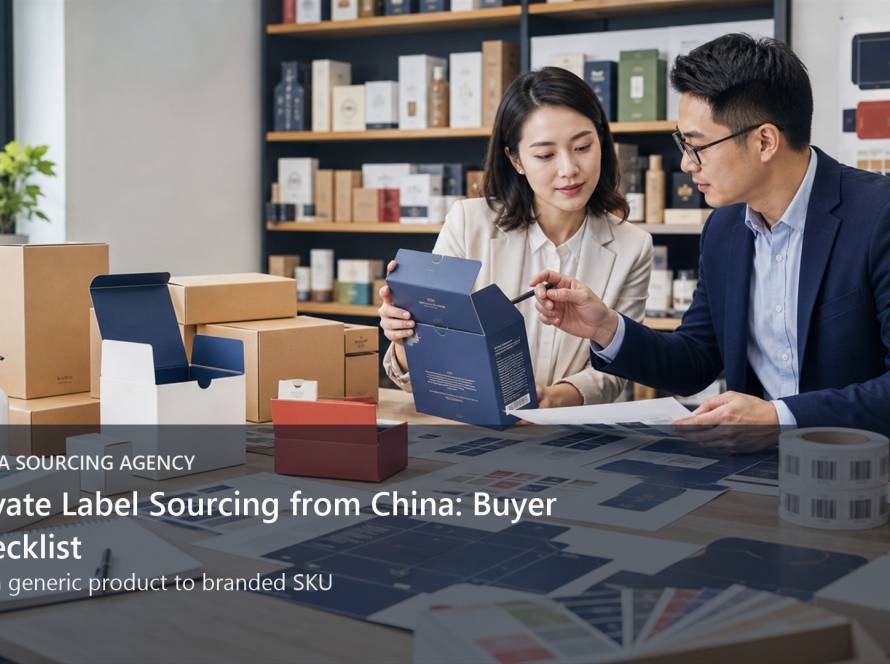
Many private label sellers differentiate themselves through packaging alone. A product that sells for $8 on Alibaba or AliExpress can retail for $24.99 on Amazon with premium custom packaging, compelling brand copy, and a professional insert card. This is where branding investment pays its highest ROI.
Step 4: Negotiate Pricing and Terms
Chinese suppliers expect negotiation. Key variables include unit price, MOQ, payment terms (typically 30% deposit, 70% before shipment), lead time, and warranty terms. Request a formal quotation (PI — Proforma Invoice) before committing. For first-time suppliers, consider using a third-party payment escrow or working with your sourcing agent to review contract terms.
Step 5: Production Oversight and Quality Control
Mass manufacturing without oversight is the most common source of private label disasters. A Golden Sample — the approved reference unit — should be confirmed before production begins. During production, conduct:
- Raw material inspection to verify inputs match specifications
- During-production inspection (typically at 30–50% completion)
- Pre-shipment inspection against AQL II standards before goods leave the factory
These three checkpoints, executed by a professional QC team, catch defects before they become a return rate problem on Amazon or a wave of negative reviews on your Shopify store. See how IFBrand Sourcing handles Mass Manufacturing oversight →
Step 6: Arrange Shipping and Fulfillment
For Amazon FBA sellers, shipping logistics are a critical cost center. Ocean freight from China to the US typically costs $800–$1,500 per CBM depending on season and route, while air freight runs 6–10x higher but delivers in 5–8 days. Your shipping and warehousing partner should handle customs documentation, FBA labeling, and carton preparation to Amazon’s strict requirements. Explore IFBrand Sourcing’s Shipping & Warehousing services →
Most Profitable Private Label Product Categories from China
Based on sales velocity, margin potential, and sourcing feasibility, these categories consistently perform well for private label sellers on Amazon, Shopify, and eBay:
| Category | Avg. China FOB Price | Target Retail Price | Margin Potential |
| Kitchen gadgets | $1.50 – $5.00 | $14.99 – $29.99 | 60–75% |
| Beauty & personal care | $2.00 – $8.00 | $19.99 – $39.99 | 65–75% |
| Pet accessories | $3.00 – $10.00 | $19.99 – $49.99 | 60–70% |
| Fitness & yoga | $4.00 – $12.00 | $24.99 – $59.99 | 60–72% |
| Phone accessories | $1.00 – $4.00 | $9.99 – $24.99 | 55–70% |
| Outdoor & camping | $5.00 – $18.00 | $29.99 – $79.99 | 55–68% |
These figures reflect typical FOB prices from verified Chinese manufacturers, not retail prices on Alibaba or AliExpress, which include significant markup.
📱 Social Media Insight: What’s Working Right Now
Material Science Sells. One of the most shareable content formats for private label brands is material education — explaining why 304 stainless steel outperforms 201, or why platinum-cured silicone matters for food safety. These posts consistently drive saves and shares on Instagram and Pinterest, and position your brand as an authority rather than just another reseller.
YouTube Case Study: IFBrand Sourcing’s YouTube channel recently published “The Jump Starter Sourcing Problem Nobody’s Talking About” — a real-world breakdown of how hidden component substitution derails private label quality. This type of behind-the-scenes content is exactly what resonates with Amazon sellers and Shopify brand owners on Reddit’s r/FulfillmentByAmazon and r/ecommerce communities.
🎥 Watch the IFBrand Sourcing YouTube channel for real sourcing case studies: youtube.com/@IFBrandSourcing-IFB
Common Mistakes to Avoid
Many sellers damage their private label business before launch by making predictable errors. The most damaging include:
- Sourcing from unverified Alibaba listings without factory audits
- Skipping sample evaluation to save time
- Failing to account for all-in landed costs (duties, FBA fees, shipping)
- Launching with generic packaging that fails to differentiate the product on Amazon search results
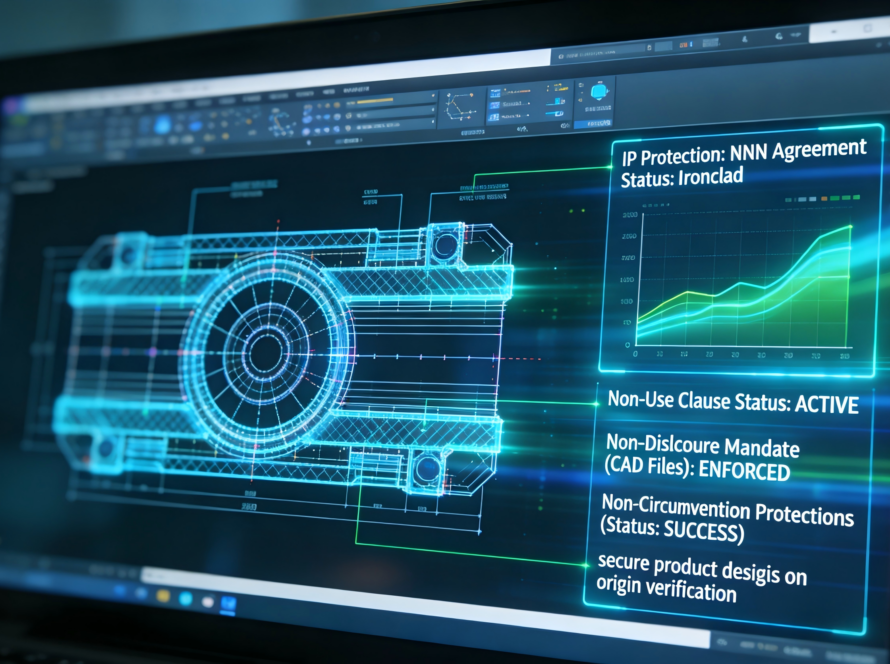
A subtler but equally serious mistake is ignoring intellectual property. Selling products that inadvertently infringe on existing patents can result in Amazon ASIN suspension and significant legal liability. Always conduct a patent search before finalizing your product, and work with your sourcing agent to ensure your customizations are contractually protected under a signed NDA.
The Role of a China Sourcing Agent in Private Labeling
For brands sourcing their first or second private label product, a professional sourcing agent provides an asymmetric advantage. Rather than spending weeks navigating Alibaba, translating communications, and hoping factory claims are accurate, an experienced agent like IFBrand Sourcing handles the full process: supplier identification, factory audit, sample coordination, price negotiation, production oversight, QC inspection, and logistics.
This is not merely a convenience — it is a risk management tool. The cost of a sourcing agent fee (typically 5–10% of order value) is trivial compared to the cost of receiving 1,000 defective units, facing an Amazon suspension, or missing a peak season launch window.
Frequently Asked Questions (FAQ)
Q1: What is the minimum order quantity (MOQ) for private label products from China?
MOQ varies widely by product category and factory size. Most consumer product factories require a minimum of 100–500 units per SKU, though some accept lower quantities for simpler products. Custom packaging typically requires a separate MOQ of 500–1,000 units from packaging suppliers. A sourcing agent can negotiate lower MOQs for your first trial order.
Q2: How long does it take to source and receive private label products from China?
The typical timeline from supplier selection to delivery at your Amazon FBA warehouse is 60–90 days: 7–14 days for sampling, 30–45 days for production, and 20–35 days for ocean freight. Air freight reduces the shipping portion to 5–8 days but significantly increases cost.
Q3: Is it safe to pay Chinese suppliers through Alibaba’s Trade Assurance?
Alibaba’s Trade Assurance provides some payment protection for orders placed through the platform, but it has limitations. For larger orders or custom products, working with a sourcing agent who reviews contracts and supervises production provides substantially stronger protection than platform insurance alone.
Q4: Do I need a company or business license to import private label products from China?
In the United States, you do not need a formal business license to import goods, but you do need an Importer of Record (IOR) designation and an EIN for US Customs. For Amazon FBA, you also need a registered seller account and compliance with any category-specific documentation.
Q5: How do I ensure my private label products comply with US or EU safety standards?
Compliance requirements depend on the product category. Electronics require FCC and CE certification; children’s toys require ASTM F963 or EN 71; food-contact items require FDA or LFGB compliance. Your sourcing agent or factory should provide testing reports from accredited third-party laboratories (SGS, Bureau Veritas, TÜV Rheinland) before shipment.
Q6: Can I sell the same private label product on both Amazon and my Shopify store?
Yes, and many successful e-commerce brands use a multi-channel strategy. Amazon provides organic traffic and buy box exposure, while Shopify offers higher margins and direct customer relationships. Many brands also list on eBay for additional reach. Ensure your private label packaging and brand identity are consistent across all channels for maximum brand equity.
Conclusion
Private labeling from China remains one of the most accessible and scalable paths to building a profitable e-commerce brand on Amazon, Shopify, eBay, or through Alibaba wholesale channels. Success requires disciplined product selection, rigorous supplier vetting, professional quality control, and smart logistics management.
IFBrand Sourcing provides end-to-end Product Sourcing services — from initial supplier identification and factory audit to mass manufacturing oversight and global shipping. Our team has helped brands across North America, Europe, and Australia bring quality Chinese products to market with confidence.
📣 Join the conversation: Share your private label sourcing questions on Reddit’s r/FulfillmentByAmazon or r/ecommerce — and follow IFBrand Sourcing on YouTube for real-world sourcing case studies every week.
Ready to start your private label journey? Contact IFBrand Sourcing →
Document compiled by IFBrand Sourcing Content Team | ifbrandsourcing.com