
Introduction

Trans-Pacific shipping costs obliterate e-commerce profit margins continuously. Retail brands struggle to survive these massive international freight spikes safely. You must optimize your global container logistics immediately to protect your venture capital. Mastering the exact process of consolidating ocean freight china unlocks massive operational liquidity instantly. Fragmented shipping schedules bleed your daily budget rapidly. You cannot afford to ship half-empty steel containers across the global ocean network. Every single cubic meter represents massive financial investment.
Amateur procurement officers ignore international freight physics completely. They instruct multiple separate factories to ship small individual orders randomly. These separate factories book extremely expensive express courier air freight individually. The buyer receives dozens of chaotic, uncoordinated packages over several weeks. This fragmented supply chain generates massive redundant customs clearance fees. Terminal operators charge severe storage penalties for every single disorganized delivery. You surrender your profit margins entirely to greedy logistics brokers.
You must centralize your international supply chain entirely today. You require a localized master warehouse to command your global distribution network. This technical guide deconstructs the absolute physics of LCL cargo consolidation. We analyze precise cubic meter mathematics and advanced terminal customs clearance. We reveal exactly how deploying an integrated forwarding strategy guarantees absolute financial dominance.
The Mechanics of LCL (Less than Container Load)
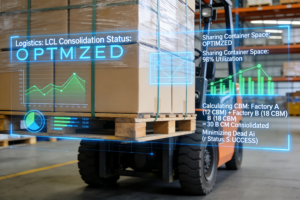
Filling a massive 40-foot High Cube container requires enormous retail inventory volumes continuously. Small startups lack the working capital to purchase sixty cubic meters of stock instantly. We utilize advanced Less than Container Load (LCL) strategies to bypass this barrier. We engineer shared shipping environments to split the massive ocean freight costs.
Calculating CBM (Cubic Meters)
Ocean freight carriers charge strictly by volumetric mass, never by pure physical weight. We measure the master export cartons using exact metric dimensions. We multiply the length, width, and height to calculate the exact Cubic Meter (CBM) footprint. We map this total volume digitally against the interior container geometry perfectly. This mathematical calculation dictates your exact proportionate share of the total container cost. We execute flawless freight forwarding optimization to drop your landed cost per unit massively.
Sharing Container Space
LCL shipping requires strict physical coordination between multiple unrelated commercial brands. Stevedores load your distinct pallets alongside machinery, textiles, or electronics from other global buyers. We must ensure the port loaders place your fragile retail goods safely. Heavy industrial machinery can crush weak cardboard cartons during violent ocean storms easily. We dictate specific top-loading requirements to the consolidation warehouse strictly. We guarantee your fragile consumer packaging survives the turbulent marine journey perfectly intact.
Minimizing Dead Air
Shipping empty space costs exactly the same amount as shipping solid metal. Factories frequently utilize oversized master cartons filled entirely with useless foam peanuts. This dead air inflates your CBM calculation and destroys your profit margin instantly. We engineer custom master export cartons to nest your specific retail products tightly. We eliminate every single millimeter of dead volumetric space. We deploy these advanced engineering tactics specifically to reduce shipping costs for your business.
Centralizing Inventory in a Shenzhen Warehouse
Furthermore, multi-factory procurement requires absolute logistical synchronization constantly. Consequently, we deploy our massive centralized hub perfectly for global retail buyers. Therefore, we collect your scattered inventory securely under one heavy industrial roof. Moreover, this localized consolidation eliminates expensive international fragmented shipments completely. Thus, we control your entire commercial rollout schedule with absolute mathematical precision.
Receiving Goods from Multiple Factories
Furthermore, modern hardware brands utilize dozens of distinct specialized component factories. Consequently, the plastic factory finishes production three weeks before the printed circuit board facility. Therefore, we coordinate local domestic trucking networks to collect these finished batches individually. Moreover, we store the early shipments securely inside our secure regional facility. Thus, we build your complete inventory order safely before booking the expensive ocean vessel. We provide elite China warehouse storage for ambitious enterprises.
Executing Final QA Inspections
Consequently, blind shipping from third-party factories invites catastrophic consumer defect rates constantly. Therefore, we utilize this centralized warehouse staging period to execute severe quality control. Furthermore, our dedicated engineers unpack the factory cartons directly on our secure loading dock. Moreover, we test the electronic functions and verify the cosmetic surface finishes strictly. Thus, we reject defective merchandise before it ever crosses the international ocean border. Consequently, we force the local factories to replace damaged units rapidly.
Palletizing and Shrink Wrapping
Moreover, loose cardboard cartons suffer severe kinetic damage during chaotic terminal loading operations. Therefore, we stack your master cartons onto heavy-duty ISPM-15 certified wooden pallets securely. Consequently, technicians wrap the entire pallet utilizing thick industrial polyethylene shrink film. Furthermore, we apply heavy plastic corner protectors to prevent strap damage completely. Thus, forklift operators handle your consolidated cargo smoothly without dropping individual boxes. We execute flawless LCL consolidation Shenzhen protocols every single day.
Comparison Matrix: Export Routing Methodologies
Logistics officers evaluate freight costs, customs paperwork, and inventory control constantly. They analyze comparative supply chain data to optimize global retail operations heavily. The following matrix contrasts core export routing models based on freight cost, documentation complexity, and overall cargo security:
| Export Methodology | Total Ocean Freight Cost | Customs Paperwork & Bureaucracy | Inventory Control & Cargo Security |
| Consolidated Warehouse Shipping | Extremely Low. You share the container cost mathematically based strictly on your exact CBM footprint. Maximizes profit entirely. | Streamlined. The forwarder merges all factory invoices into one single commercial invoice. Requires only one customs entry fee. | Absolute. The agent inspects, palletizes, and wraps the cargo before export. Prevents factory fraud and catastrophic ocean damage. |
| Direct Factory Shipping (Fragmented) | Astronomical. Each factory books independent LCL space. You pay redundant base terminal handling charges (THC) repeatedly. | Chaotic. You receive a dozen separate commercial invoices and Bill of Ladings. Your destination broker charges you multiple clearing fees. | Zero. The factory packs the container blindly. You discover massive quality defects only after the container reaches your domestic warehouse. |
| Express Air Courier (DHL/FedEx) | Astronomical. Air freight charges scale violently based on volumetric weight. Viable only for tiny, extremely high-margin electronics. | Automated. The courier company clears customs electronically during the flight. Minimal paperwork required from the buyer. | High. The courier tracks the package digitally at every single transfer hub. Delivers straight to your warehouse door rapidly. |
Customs Clearance and Document Aggregation
Executing a flawless international import requires absolute legal and bureaucratic compliance continuously. Destination customs officers inspect heavy commercial shipments with extreme legal scrutiny. Fragmented paperwork triggers immediate cargo impoundment and intense government audits. We must engineer these specific commercial documents to guarantee rapid terminal clearance. We eliminate costly storage penalties across your entire supply chain.
Merging Commercial Invoices
Purchasing goods from five distinct factories generates five completely different commercial invoices normally. Presenting five separate invoices to your destination customs broker creates massive confusion. The broker charges you five distinct electronic filing fees instantly. We solve this by purchasing the goods locally under our central export license. We generate one single, unified commercial invoice covering your entire consolidated shipment perfectly. We slash your bureaucratic overhead fees and streamline your corporate accounting effortlessly.
Streamlining Bill of Lading (BOL)
The Bill of Lading represents the absolute legal title to your ocean cargo. Fragmented shipping requires managing multiple separate BOL documents simultaneously. We consolidate your inventory and generate one single Master Bill of Lading (MBL) securely. We process the required Telex Release electronically before the vessel arrives. Your destination forwarder utilizes this single document to claim the entire container instantly. We execute flawless international trade compliance continuously for your brand.
Avoiding Demurrage Fees
Port authorities charge exorbitant daily storage fees once your container exceeds its free time. We call these severe financial penalties demurrage and detention fees. Fragmented shipments frequently get stuck at customs due to inconsistent factory HS tariff codes. These paperwork errors trap your cargo at the port, bleeding your cash reserves rapidly. We audit every single HS code before loading the container in Shenzhen. We ensure rapid clearance, preventing terminal demurrage penalties entirely.
Frequently Asked Questions (FAQ)
- How do you calculate volumetric weight for air freight vs sea freight?
Ocean freight (LCL) strictly utilizes the Cubic Meter (CBM). 1 CBM equals 1,000 Kilograms of theoretical mass. Air freight utilizes a strict dimensional divisor (typically 5000 or 6000). The airline multiplies Length x Width x Height (in cm) and divides by the divisor to determine the chargeable weight.
- Who provides marine insurance for a consolidated LCL shipment?
You must purchase comprehensive ‘All-Risk’ marine insurance directly through your freight forwarder or a third-party broker. The individual factories hold zero liability once the cargo leaves their loading dock. Insurance protects you from total loss if the ocean vessel encounters catastrophic cyclonic weather.
- Does LCL consolidation increase the overall ocean transit time?
Yes, slightly. Direct FCL (Full Container Load) moves from the port immediately. LCL requires an additional 3 to 5 days at the origin port for the warehouse to consolidate multiple shipments into one container. It requires another 3 to 5 days at the destination port to deconsolidate the mixed cargo.
- What happens if another company’s cargo inside the LCL container gets flagged by customs?
This is the primary risk of LCL shipping. If customs flags a single pallet inside the shared container for an intensive physical exam, they hold the entire container. Your legal cargo remains trapped at the terminal until customs clears the other company’s problematic shipment.
- Can you ship consolidated cargo directly to an Amazon FBA center?
Absolutely. We specialize in Amazon FBA logistics. We consolidate the inventory in Shenzhen, ship it LCL across the Pacific, deconsolidate it at our Los Angeles warehouse, and truck your specific pallets directly into the Amazon fulfillment network seamlessly.
- Are ISPM-15 wooden pallets strictly required for LCL ocean shipping?
Yes. International phytosanitary laws mandate that all solid wood packaging materials must undergo strict heat treatment or fumigation to kill wood-boring insects. We utilize certified ISPM-15 stamped pallets exclusively to ensure your cargo passes destination customs inspections instantly without quarantine delays.
Conclusion
The logistical reality within the global manufacturing market remains irrefutable constantly. Relying on fragmented supply chains executing uncoordinated factory shipments destroys your commercial budget instantly. You must route your international cargo through a highly verified localized consolidation hub. We engineer perfect maritime strategies that guarantee absolute cargo safety and financial liquidity. By migrating your logistics to our dedicated team, you acquire flawless supply chain stability. We excel at securing shipping and warehousing architecture completely.
Partner with an elite logistics agency today to eliminate catastrophic terminal penalties forever. We deliver precision maritime oversight directly from our headquarters in Shenzhen. Secure your bulk ocean consolidation with our expert customs brokers. Upgrade your global distribution network utilizing our premium China product sourcing division. Contact the experts at IFBrand Sourcing and revolutionize your international fulfillment cycle now.